A company's equipment fleet represents all the equipment, machines, tools, and physical materials used to carry out its professional activities. It plays an essential role in the smooth running of the company. In this article, we'll define what a company's equipment fleet is and why it matters for improving company productivity.
What is a company's equipment fleet? Definition
The equipment fleet encompasses all the tangible assets owned by the company. It is made available to employees so they can carry out their professional duties. It can include various types of equipment, such as IT hardware, furniture, vehicles, work clothing, or tools and physical materials.
These physical assets can be:
- Purchased or rented depending on the company's needs and resources
- Used across different industries (manufacturing, retail, services, agriculture, construction, etc.)
Company equipment and materials: why does it matter?
The role of the equipment fleet in quality of life and workplace safety
Equipment that is in good condition and suited to employees' needs is important. It contributes greatly to employee productivity and satisfaction, starting from the moment they join the company. Providing an optimal work environment is a clear advantage when it comes to recruiting and retaining employees.
In addition, well-maintained equipment also contributes to employee safety. It helps reduce the risk of accidents caused by faulty equipment. It's also important to follow the standards that apply to your equipment fleet to ensure compliance with current regulations.
Equipping yourself with the right equipment to optimize your business
An equipment fleet suited to the company's needs helps improve processes. This could mean a company car for a salesperson who travels frequently, the IT equipment needed for a developer's job, or tools for an electrician.
In certain industries, such as manufacturing, modern, efficient machinery can increase production capacity, reduce downtime, and optimize manufacturing costs.
Profitability and return on investment for equipment
While the initial investment in an equipment fleet can be costly, it can prove very profitable in the long run. Quality equipment helps save time and reduce maintenance costs, thereby improving the company's overall productivity.
Equipment fleet management: a mission with many challenges
Optimizing equipment fleet management and ensuring it runs smoothly requires precise, optimal oversight. Indeed, equipment management is a mission with many challenges:
- Optimizing equipment usage
- Allocation to employees
- Controlling fleet expenses and costs
- Regular tracking of maintenance and contracts related to equipment
- Ensuring equipment compliance with current regulations
- Equipment durability
To address these challenges, precise equipment tracking is essential. However, this kind of management can prove complex and time-consuming. As a result, many companies use dedicated equipment and asset management software.
The benefits of using software to manage your equipment fleet
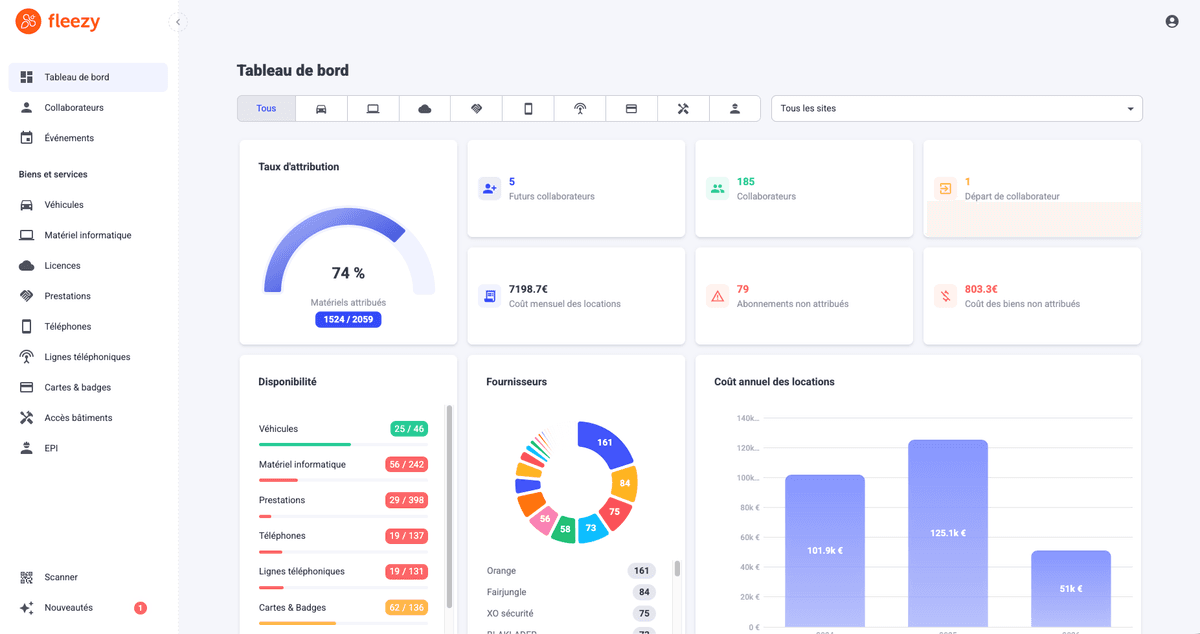
Equipment management software is a solution that allows you to track your assets and all related events in real time. It's a tool that can support small businesses as well as large organizations. Equipping yourself with management software offers many benefits:
- Centralizing all your asset data within a single tool
- Gaining full visibility over your assets, their history, and their allocation to employees
- Getting alerts about events related to your fleet (maintenance, contract end dates, etc.)
- Saving money by keeping overall costs under control
As you can see, a company's equipment fleet is important for its smooth operation and competitiveness. It encompasses a variety of equipment that is essential to carrying out the company's activities. Investing in quality equipment can improve many aspects: productivity, safety, employee satisfaction, and so on. Managing and maintaining this equipment is therefore essential for any company. Equipping yourself with equipment management software simplifies this task and enables optimal oversight.